
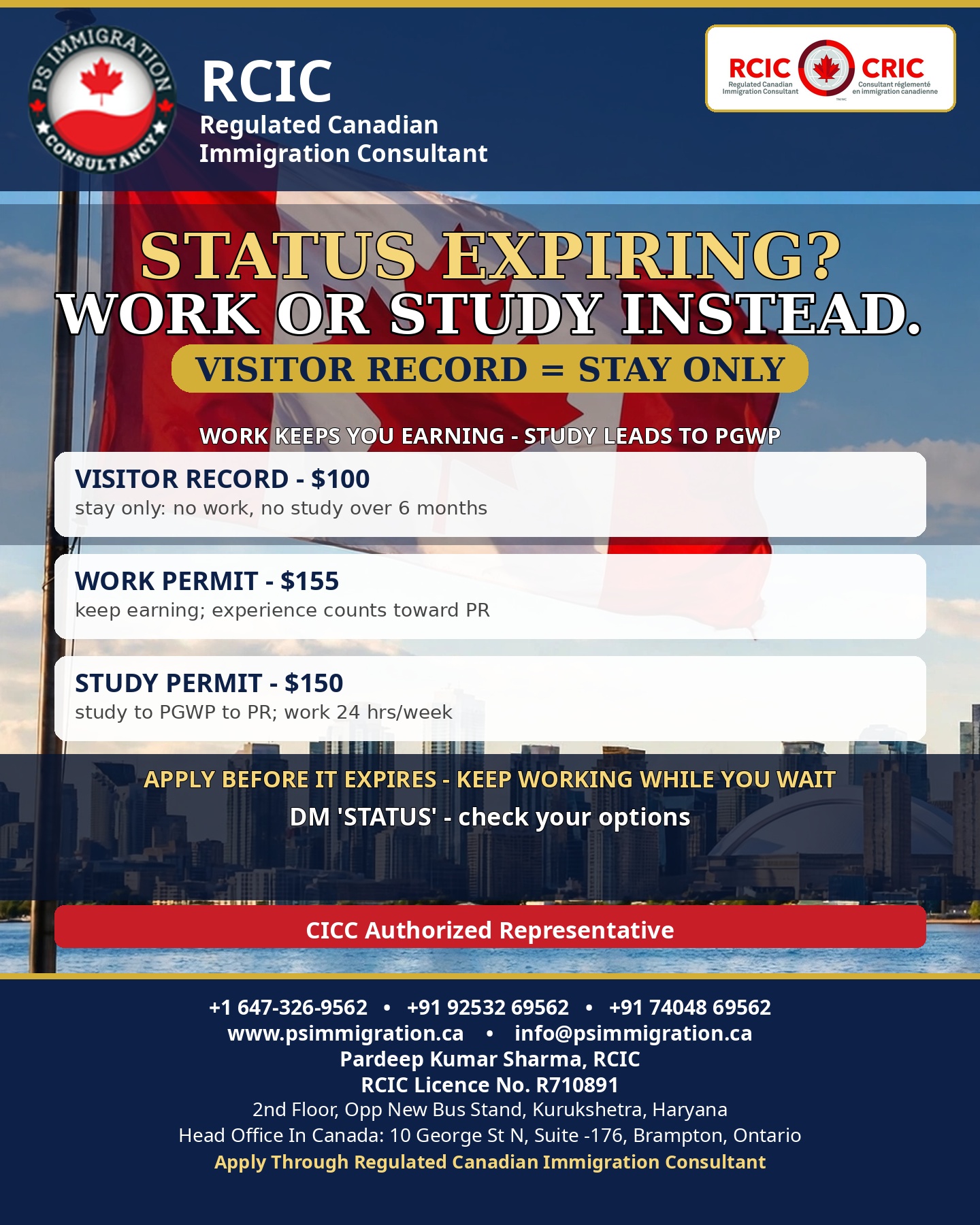
Status Expiring in Canada? Work or Study Instead of a Visitor Record
Status expiring in Canada? If your work permit or study permit is about to expire, you have a decision to make — and the easiest option is usually the weakest one. A visitor record lets you stay in Canada, but that is all it does. No work. No study in a program longer than six months. No progress toward permanent residence. And right now, a visitor-record application takes about 296 days to process.
If you qualify, a work permit or a study permit keeps your life moving — and keeps your path to PR alive. This guide explains the three options, the honest catch most articles leave out, and why the timing of your application matters more than the choice itself.
What a visitor record actually gives you
If you have status expiring in Canada, a visitor record is not a visa and not a permit to do anything except remain in Canada as a visitor. It does not authorize work, and it does not authorize study in a program longer than six months.
- Fee: $100 per person (+$85 biometrics if required)
- Apply BEFORE your status expires — IRCC recommends at least 30 days before
- If you apply on time, you get maintained status while IRCC decides
- Processing time: about 296 days (IRCC data as of 18 November 2026) — roughly ten months of waiting, during which you cannot work or study
A visitor record makes sense when you genuinely only need more time in Canada — to visit family, to wait out a decision, or to finish a short course. It does not make sense as a plan for building a life here.
Work permit instead — if you qualify
With status expiring in Canada, a work permit keeps you earning, and Canadian work experience counts toward permanent residence: one year of skilled Canadian work experience is the core requirement for the Canadian Experience Class, and it also earns CRS points.
- Fee: $155 (+$100 open work permit holder fee where it applies)
- Routes: a job offer supported by an LMIA (the employer pays $1,000, non-refundable) or an LMIA-exempt route — spousal open work permit, PGWP, bridging open work permit, Francophone Mobility, and others
- Apply before your current permit expires and you keep working under the same conditions while you wait (maintained status)
Study permit instead — if you qualify
A study permit can restart your path: study at a designated learning institution, and after graduation a Post-Graduation Work Permit (up to three years) can lead to Canadian Experience Class.
- Fee: $150
- Needs: a letter of acceptance from a DLI, a provincial attestation letter in most cases, and proof of funds — $23,448 for a single applicant
- Full-time students can work up to 24 hours a week off campus
- One warning: if you already had a PGWP, you will NOT get a second one after a new program
The honest catch — most visitors cannot apply for a work permit from inside Canada
This is the part many articles get wrong. As a plain visitor, you generally CANNOT apply for a work permit from inside Canada. IRCC's inside-Canada list is a closed list — valid work and study permit holders, their spouses and parents, PGWP-eligible students, people with a PR application awaiting a decision, protected persons, and a few others. Visitors are not on it.
The temporary public policy that let visitors apply from inside Canada ended on 28 August 2024 — IRCC ended it early, and it has not come back. See IRCC's own notice ending the policy. Flagpoling — applying at a land border — also ended for most people on 23 December 2024.
The same limit applies to study: most visitors cannot apply for a study permit from inside Canada either (exceptions include completing a prerequisite course, or being the spouse, parent or minor child of a permit holder).
So the realistic choice in this post is for people with status expiring in Canada who ALREADY hold a work or study permit: extend it, or switch to work or study, BEFORE it ends — instead of downgrading to a visitor record.
Timing is everything for status expiring in Canada — before vs after expiry
With status expiring in Canada, apply BEFORE your status expires and you get maintained status: you stay, and you keep working or studying under your old conditions while IRCC decides.
Apply AFTER your status expires and the picture changes completely:
- You have a 90-day restoration window only — and no work or study while you wait
- Restoration fees are higher: $401.25 as a worker, $396.25 as a student, $246.25 as a visitor
- You must stay in Canada while restoration is decided; leaving ends the application
- After 90 days, restoration is gone — you must leave
What to do now
- Check your expiry date today — not the date on your permit, but the date your status actually ends (for students, your study permit becomes invalid 90 days after you finish your program).
- If you have a job offer, ask whether it is LMIA-supported or LMIA-exempt — that decides your work-permit route.
- If you are considering study, get your DLI acceptance and PAL started now; both take time.
- Do not let your status lapse while you decide. A lapsed status costs you the right to work or study for months.
If you are unsure which option fits your case, DM "STATUS" on Instagram @psimmigration or call +1 647-326-9562 and we will check your options.
Published 24 Nov 2026 by PS Immigration Consultancy — Pardeep Kumar Sharma, RCIC (Licence No. R710891). Information only, not legal advice; fees and processing times are IRCC figures as of 18 November 2026 and change regularly.