
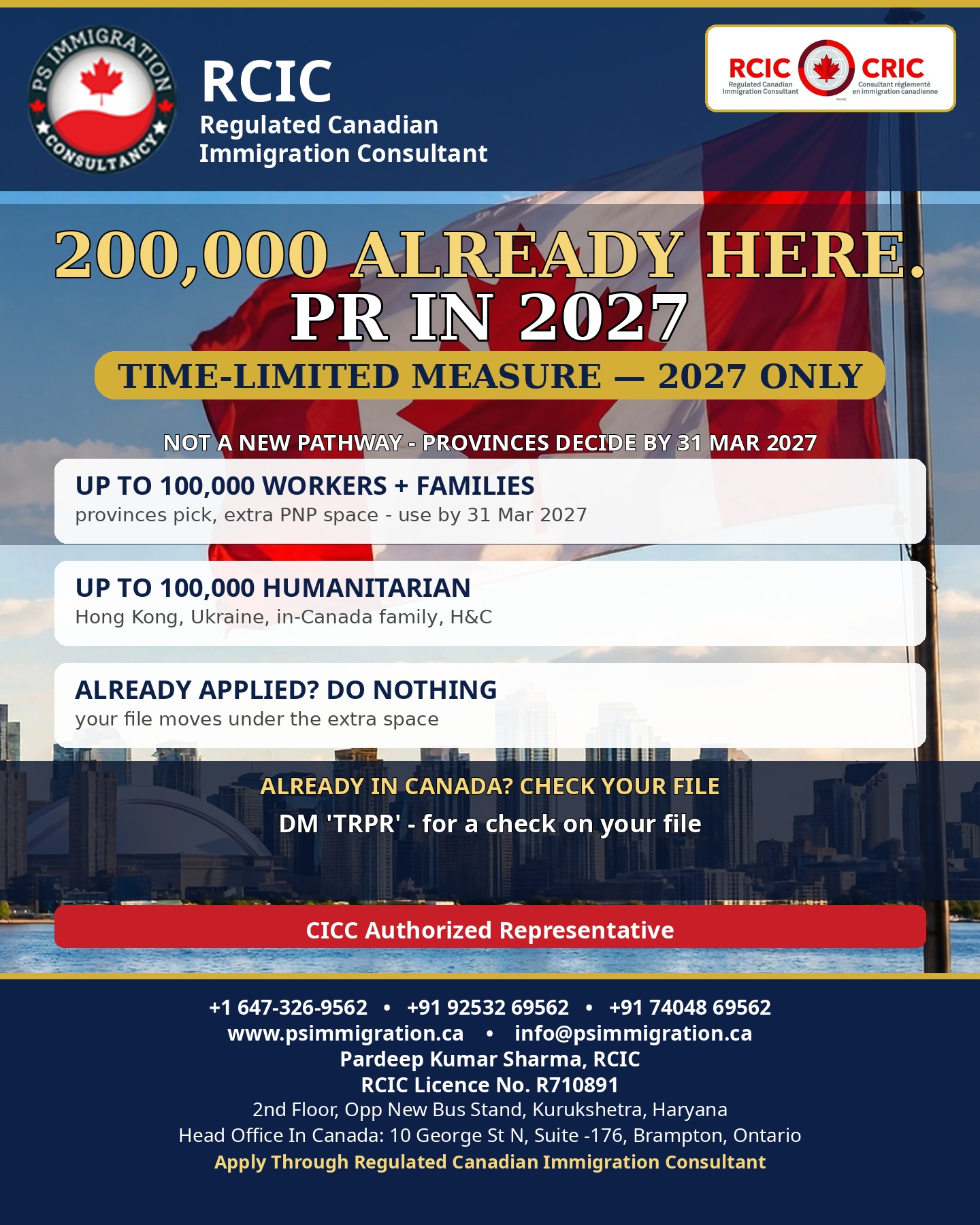
200,000 People Already in Canada Can Become Permanent Residents in 2027
200,000 People Already in Canada Can Become Permanent Residents in 2027
What was announced
In Budget 2026, announced 5 November 2026, the federal government introduced a time-limited measure to help up to 200,000 people who are already living in Canada become permanent residents in 2027. It is a one-year measure. It sits outside the 380,000 annual permanent resident target, and it will not increase admissions on a recurring basis.
The most important thing to understand: this is not a new pathway and there is no new program to apply to. The measure adds processing space to programs and queues that already exist. Nobody can promise you a spot under it, and there is no application form for it.
On 12 November 2026, Immigration Minister Lena Metlege Diab explained how the workers half of the measure will work. The details below come from IRCC's own releases.
The workers cohort — up to 100,000 people
Up to 100,000 workers already in Canada, plus their families, can transition to permanent residence through the provinces and territories. Here is how it works:
- Provinces and territories are offered optional additional Provincial Nominee Program (PNP) allocations. Each province decides how much of the extra space to take and which workers to pick, based on its own labour market needs.
- These allocations are intended to be used by 31 March 2027. That deadline is on the provinces, not on applicants — it is the date by which provinces should use the extra nominations.
- The measure covers workers living in communities outside Quebec.
- Provinces can also identify workers in their jurisdictions who already applied for permanent residence through federal programs — including the Atlantic Immigration Program, Start-up Visa, Self-Employed Persons, Agri-Food Pilot and home care worker programs — and are still waiting for a decision.
This is on top of the regular 2027 PNP target of up to 95,000. There is no published eligibility list for workers beyond provincial selection: if you are working in Canada, your province decides whether it picks you.
The humanitarian cohort — up to 100,000 people
The second half of the measure, up to 100,000 spaces, covers specific humanitarian and family groups who are already in Canada:
- In-Canada spouses, partners and dependent children of Canadians and permanent residents, with a sponsorship application already in process.
- Hong Kong permanent residence pathways — applications already submitted before the pathways closed on 31 August 2026.
- Ukraine Family Reunification Pathway — applications already submitted.
- People approved in principle on humanitarian and compassionate grounds who are waiting for a final decision.
IRCC's published planning figures for these groups are 45,000 for in-Canada family, 32,000 for Hong Kong, 18,800 for Ukraine Family Reunification and 12,600 for humanitarian and compassionate cases approved in principle. These are planning figures, not a promise to any individual — and both the Hong Kong and Ukraine pathways are closed to new applications.
If you already applied for PR, do nothing
IRCC has said this clearly: people who already have a permanent residence application in process do not need to do anything or contact IRCC for it to be processed under the extra space. Your file moves under the measure on its own. Do not send duplicate applications, and do not pay anyone who offers to "register" you for the 200,000 spaces — there is no registration.
What this measure is not
- It is not a new immigration program. There is no intake, no new eligibility stream and no form to fill in.
- It does not help people outside Canada. It is only for people already living here.
- It does not reopen closed programs. The Start-up Visa closed to new applications on 31 December 2025, the Self-Employed Persons Program has been paused since 30 April 2024, and the Parents and Grandparents Program remains paused for new applications.
- It does not change Express Entry draws. Invitation rounds are still paused while IRCC recalculates CRS scores under the new rules from 3 November 2026 — no draw has been held since round #453 on 28 October 2026.
What to do now
- If you are working in Canada: keep your status valid, keep your documents current, and watch what your province does with its extra PNP space over the next few months. The provinces hold the decision.
- If your PR application is already in: do nothing. Wait for IRCC to process it under the extra space.
- If you are in one of the humanitarian groups: make sure IRCC has your current address and contact details so nothing about your file goes missing.
- If someone offers to sell you a place in the 200,000: walk away. There is nothing to buy.
If you are working in Canada now and want to know where your file stands, message us "TRPR" on Instagram or Facebook, or call +1 647-326-9562. We will check your file.
Pardeep Kumar Sharma, RCIC — Licence No. R710891, PS Immigration Consultancy, Brampton.
Read more: Levels Plan to 2029 | researchers — stipend work now counts | Family spots, already in Canada | IRCC processing times, November 2026